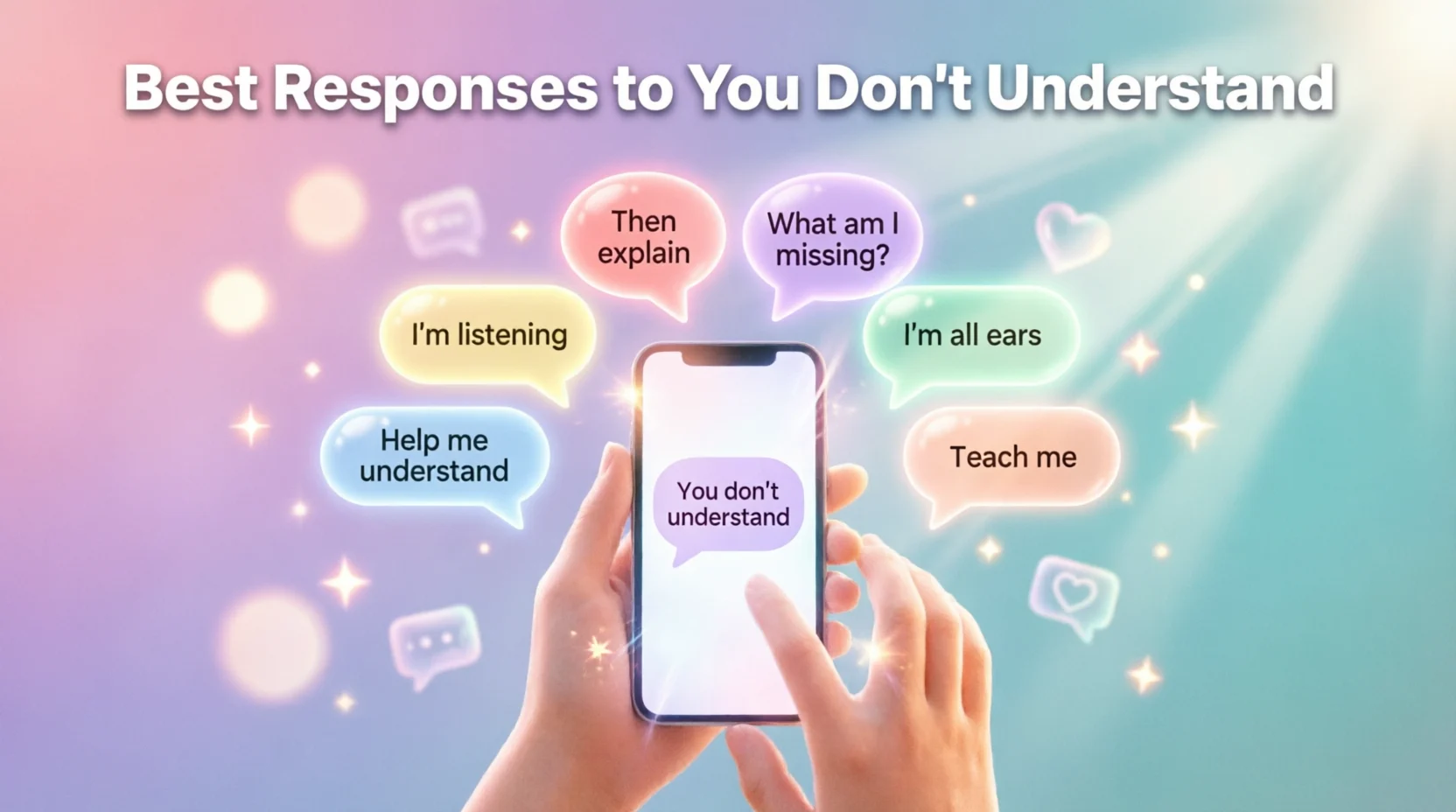
The best responses to “You don’t understand” depend on the situation and your relationship with the person. You can respond with humor, confidence, kindness, or a clever comeback without turning a small misunderstanding into a big argument.
- “Then help me understand.”
- “Maybe not, but I’m willing to listen.”
- “You could explain it instead of assuming.”
- “Fair enough, give me another chance.”
- “I understand more than you think.”
Ever tried explaining your point to someone, only to hear, “You don’t understand”? Ouch! Whether it happens during a text conversation, a disagreement with friends, a work discussion, or a slightly awkward moment with your crush, those four words can make you feel misunderstood or shut out.
The tricky part is knowing what to say next. Should you respond with a funny comeback, stay calm, ask for clarification, or show the other person that you’re genuinely listening? The right answer depends on the situation, your relationship, and the tone of the conversation.
This collection of the best responses to you dont understand gives you plenty of ready-to-use replies for different moods and personalities. From playful one-liners to confident statements and thoughtful responses, you’ll find something that fits. After all, you don’t have to win every argument to make your point. Sometimes, the smartest response is the one that keeps the conversation going.
1. Funny Responses to “You Don’t Understand”
Sometimes, a little humor can make a tense conversation feel less serious. These funny replies work best with people who appreciate a joke.
1. “Then my brain needs a software update.”
Example: When a friend says you missed the point of their complicated story.
Meaning: You use self-deprecating humor to keep things light.
2. “Okay, professor, teach me your ways.”
Example: When someone acts like the ultimate expert during a casual discussion.
Meaning: You playfully invite them to explain themselves.
3. “My understanding subscription must have expired.”
Example: When you want to joke about missing an obvious detail.
Meaning: You turn confusion into a lighthearted moment.
4. “Can I get subtitles for this conversation?”
Example: When someone explains something in a confusing way.
Meaning: You admit you’re lost without making things awkward.
5. “My brain is buffering. Give it a second.”
Example: When you need more time to process someone’s explanation.
Meaning: You make your confusion sound funny and relatable.
6. “Did I miss the episode where this made sense?”
Example: When a friend’s explanation suddenly takes an unexpected turn.
Meaning: You joke that you need more context.
7. “Please explain it like I’m on one percent battery.”
Example: When you’re tired and struggling to follow a long explanation.
Meaning: You ask for a simpler explanation with humor.
8. “I promise my brain is trying its best.”
Example: When someone teases you for not understanding a complicated topic.
Meaning: You respond with friendly humor instead of defensiveness.
9. “Is there a tutorial for this?”
Example: When someone introduces an idea that seems impossible to follow.
Meaning: You humorously ask for guidance.
10. “Hold on, let me activate my detective mode.”
Example: When a friend gives you a confusing explanation.
Meaning: You show you’re willing to investigate the situation.
11. “My last two brain cells are having a meeting.”
Example: When joking with a friend about a confusing situation.
Meaning: You use exaggerated humor to make the moment less tense.
12. “Then clearly, we need a better presentation.”
Example: When someone explains something without making it clear.
Meaning: You gently suggest that the explanation needs improvement.
2. Confident Responses to “You Don’t Understand”
A confident reply lets you stand your ground without insulting the other person. Use these when you want to be taken seriously.
1. “Maybe not completely, but I’m willing to learn.”
Example: When someone questions your understanding during a discussion.
Meaning: You show confidence while remaining open-minded.
2. “Then explain your point clearly.”
Example: When someone dismisses your opinion without offering details.
Meaning: You ask them to communicate more effectively.
3. “Don’t assume what I understand.”
Example: When someone repeatedly underestimates your ability to follow a conversation.
Meaning: You establish a boundary against unfair assumptions.
4. “I understand enough to ask the right questions.”
Example: When someone mistakes your questions for a lack of knowledge.
Meaning: You remind them that curiosity is part of understanding.
5. “Give me the facts, and I’ll decide.”
Example: When someone expects you to accept their opinion without explanation.
Meaning: You show that you prefer evidence over assumptions.
6. “I’m listening, so make your point.”
Example: When you want to move a frustrating conversation forward.
Meaning: You invite a direct and meaningful explanation.
7. “You can clarify without dismissing me.”
Example: When someone makes you feel foolish for asking questions.
Meaning: You confidently request respectful communication.
8. “Understanding takes communication from both sides.”
Example: When a disagreement involves unclear explanations.
Meaning: You emphasize shared responsibility.
9. “I know what I understand and what I don’t.”
Example: When someone insists that you know nothing about a subject.
Meaning: You express self-awareness and confidence.
10. “Let’s focus on the point, not assumptions.”
Example: When an argument starts becoming personal.
Meaning: You redirect attention toward the actual issue.
11. “I’m open to your explanation, not your judgment.”
Example: When someone criticizes you instead of explaining their perspective.
Meaning: You welcome information while rejecting condescension.
12. “You haven’t explained it fully yet.”
Example: When someone claims you don’t understand but leaves out important details.
Meaning: You point out that more communication is needed.
3. Polite Responses to “You Don’t Understand”
Polite replies are useful when you want to preserve a friendship, avoid unnecessary conflict, or keep a conversation respectful.
1. “Maybe you’re right. Could you explain a little more?”
Example: When discussing a topic you genuinely find confusing.
Meaning: You acknowledge the possibility of a misunderstanding.
2. “I’d like to understand your perspective better.”
Example: When a friend shares an opinion different from yours.
Meaning: You show genuine interest in their point of view.
3. “I’m sorry if I misunderstood you.”
Example: When your response suggests you interpreted their words incorrectly.
Meaning: You accept the possibility of confusion without assigning blame.
4. “Could you help me see what I’m missing?”
Example: When someone points out a detail you overlooked.
Meaning: You invite constructive clarification.
5. “Let me listen again and make sure I understand.”
Example: When a conversation becomes confusing or emotionally charged.
Meaning: You demonstrate patience and a willingness to listen.
6. “I might be missing some context.”
Example: When you don’t have all the information behind someone’s decision.
Meaning: You acknowledge that additional details could change your understanding.
7. “Thank you for explaining. Could you elaborate?”
Example: When someone begins explaining a complicated idea.
Meaning: You encourage them to provide more detail.
8. “I see your point, although I may view it differently.”
Example: When you understand their argument but disagree with it.
Meaning: You separate understanding from agreement.
9. “Let’s talk it through together.”
Example: When a misunderstanding is creating tension between friends.
Meaning: You suggest cooperation instead of confrontation.
10. “I didn’t mean to misunderstand your point.”
Example: When your words unintentionally upset someone.
Meaning: You clarify your intentions and show consideration.
11. “Please tell me which part isn’t clear to me.”
Example: When someone says you’re missing something important.
Meaning: You ask for specific feedback.
12. “I’m happy to hear your explanation.”
Example: When someone wants to clarify their feelings or opinion.
Meaning: You keep the conversation welcoming and respectful.
4. Sarcastic Responses to “You Don’t Understand”
A little sarcasm can be entertaining when both people understand the joke. Keep it playful rather than personal.
1. “Oh, thank you for that detailed explanation.”
Example: When someone says you don’t understand but hasn’t explained anything.
Meaning: You point out the lack of useful information sarcastically.
2. “Right, because you’ve explained everything so clearly.”
Example: When someone gives a vague explanation and blames you for being confused.
Meaning: You highlight the gap between their explanation and your understanding.
3. “My apologies, I forgot to read your mind.”
Example: When someone expects you to know something they never mentioned.
Meaning: You sarcastically remind them that communication matters.
4. “Should I guess the missing information?”
Example: When important details are being left out of a discussion.
Meaning: You point out that you cannot understand what hasn’t been explained.
5. “Amazing. What an educational experience.”
Example: When someone acts superior instead of helping you understand.
Meaning: You use irony to express mild frustration.
6. “And your explanation is doing wonders.”
Example: When an explanation makes the subject even more confusing.
Meaning: You sarcastically criticize the clarity of their explanation.
7. “I’ll wait for the part where it makes sense.”
Example: When someone presents an unclear argument with great confidence.
Meaning: You question whether their explanation is understandable.
8. “Good thing you told me instead of explaining it.”
Example: When someone repeats that you’re confused without offering help.
Meaning: You highlight how unhelpful their response is.
9. “The mystery continues.”
Example: When a conversation ends without clarifying anything.
Meaning: You humorously acknowledge that the confusion remains.
10. “Well, that cleared up absolutely nothing.”
Example: When their explanation leaves you with more questions.
Meaning: You express frustration through dry humor.
11. “I’ll add mind reading to my skill set.”
Example: When someone expects you to infer information they haven’t shared.
Meaning: You point out their unrealistic expectation sarcastically.
12. “Please continue. I’m learning what not to do.”
Example: When someone explains something in an unnecessarily condescending way.
Meaning: You use irony to challenge their attitude.
5. Flirty Responses to “You Don’t Understand”
If your crush or partner says this playfully, a charming response can keep the conversation going without making things too serious.
1. “Then you’ll have to spend more time explaining it to me.”
Example: When your crush teases you about not understanding their point.
Meaning: You turn the situation into an opportunity for more conversation.
2. “Maybe I just need your personal tutorial.”
Example: When someone you like is explaining a hobby or interest.
Meaning: You express interest with a playful tone.
3. “You’re right, I’m a little distracted by you.”
Example: When you’re chatting with someone you have a crush on.
Meaning: You use a light compliment to show attraction.
4. “Guess we’ll have to keep talking until I get it.”
Example: When you want to extend an enjoyable conversation.
Meaning: You suggest spending more time together.
5. “Then explain it to me over coffee.”
Example: When the conversation naturally leads to making plans.
Meaning: You introduce a casual invitation.
6. “I understand one thing: you’re interesting.”
Example: When your crush jokes about your confusion.
Meaning: You shift the conversation toward a charming compliment.
7. “Maybe your explanation needs a little more charm.”
Example: When someone playfully claims you aren’t following along.
Meaning: You flirt by teasing them about their communication.
8. “I’m listening. You have my attention.”
Example: When someone you like wants to share something important.
Meaning: You show interest and attentiveness.
9. “Then give me another chance to impress you.”
Example: When you want to keep playful banter alive.
Meaning: You show confidence while inviting more interaction.
10. “I might understand better if you smiled first.”
Example: When a friendly conversation has a teasing atmosphere.
Meaning: You offer a gentle, flirtatious compliment.
11. “You make confusing sound surprisingly interesting.”
Example: When someone you like is explaining something unfamiliar.
Meaning: You suggest that their company makes the conversation enjoyable.
12. “Maybe we understand each other better than you think.”
Example: When you share a playful moment with someone special.
Meaning: You hint at a connection without making a big declaration.
6. Professional Responses to “You Don’t Understand”
At work, the best reply is calm, constructive, and focused on the task. These responses help you avoid unnecessary tension with coworkers or managers.
1. “Could you clarify which part needs further explanation?”
Example: When a colleague says you’ve misunderstood a project requirement.
Meaning: You ask for specific, actionable clarification.
2. “Let’s review the details together.”
Example: When a team discussion reveals different interpretations of a task.
Meaning: You encourage collaboration and shared understanding.
3. “I may be missing some context. Could you provide it?”
Example: When a project decision depends on information you haven’t received.
Meaning: You request the background needed to understand the issue.
4. “I’d appreciate a specific example.”
Example: When feedback is too vague to act on.
Meaning: You seek practical information rather than general criticism.
5. “Let me summarize my understanding so we can identify the gap.”
Example: When aligning with a manager on project expectations.
Meaning: You use a structured approach to resolve confusion.
6. “I understand the objective, but I’d like to clarify the approach.”
Example: When the goal is clear but the implementation is not.
Meaning: You distinguish the overall purpose from the details.
7. “Could we walk through the requirements once more?”
Example: When instructions contain several complex steps.
Meaning: You request a review to prevent further mistakes.
8. “Thank you for flagging that. What should I revisit?”
Example: When a coworker identifies a possible misunderstanding.
Meaning: You respond professionally and invite useful feedback.
9. “Let’s make sure we’re aligned before moving forward.”
Example: When a team needs agreement before beginning a task.
Meaning: You prioritize clarity and coordination.
10. “I see it differently. May I explain my reasoning?”
Example: When your interpretation differs from your colleague’s.
Meaning: You express disagreement respectfully.
11. “Could you outline the specific concern?”
Example: When a discussion becomes too general to resolve.
Meaning: You bring the conversation back to concrete details.
12. “I’d like us to reach a shared understanding.”
Example: When different expectations are delaying progress.
Meaning: You focus on a productive outcome rather than blame.
7. Brutally Honest Responses to “You Don’t Understand”
Sometimes, a direct reply is necessary, especially when someone repeatedly dismisses your perspective. These statements are firm without relying on personal insults.
1. “Then explain it instead of dismissing me.”
Example: When someone refuses to clarify their point.
Meaning: You directly request an explanation rather than criticism.
2. “You haven’t given me enough information to understand.”
Example: When someone leaves out important details.
Meaning: You identify the actual communication problem.
3. “Disagreeing with you doesn’t mean I don’t understand.”
Example: When someone treats your different opinion as proof of ignorance.
Meaning: You separate disagreement from comprehension.
4. “Stop assuming you know what I understand.”
Example: When someone repeatedly speaks on your behalf.
Meaning: You set a clear boundary around unfair assumptions.
5. “I’m asking questions, not admitting defeat.”
Example: When someone interprets your curiosity as weakness.
Meaning: You defend your right to seek clarification.
6. “Your explanation needs work, not my patience.”
Example: When repeated explanations remain unnecessarily confusing.
Meaning: You firmly point out the need for clearer communication.
7. “You can disagree without talking down to me.”
Example: When someone uses a condescending tone during an argument.
Meaning: You insist on respectful treatment.
8. “Don’t confuse my silence with a lack of understanding.”
Example: When someone assumes you’re lost because you’re quiet.
Meaning: You remind them not to make conclusions without evidence.
9. “I’m willing to listen, but I’m not here to be belittled.”
Example: When a discussion becomes disrespectful.
Meaning: You establish a boundary while remaining open to dialogue.
10. “If you want to be understood, communicate clearly.”
Example: When someone repeatedly complains about misunderstandings.
Meaning: You emphasize the responsibility to explain ideas clearly.
11. “Let’s discuss the facts instead of judging my intelligence.”
Example: When someone makes a disagreement personal.
Meaning: You redirect attention toward evidence and reasoning.
12. “I’ll listen to an explanation, not an insult.”
Example: When someone replaces helpful feedback with disrespectful remarks.
Meaning: You make it clear that constructive communication is welcome.
8. Cute Responses to “You Don’t Understand”
Cute replies are ideal for friendly conversations where you want to sound approachable, a little silly, and easy to talk to.
1. “Help me understand, please?”
Example: When a friend explains something you haven’t encountered before.
Meaning: You ask for help in a gentle way.
2. “My brain needs a tiny hug and another explanation.”
Example: When you’re struggling to follow a complicated story.
Meaning: You use affectionate humor to make confusion less awkward.
3. “I’m trying, promise!”
Example: When someone playfully teases you for missing a detail.
Meaning: You show effort in a warm, friendly way.
4. “Can we start from the beginning?”
Example: When you’ve lost track of a friend’s explanation.
Meaning: You request a fresh start without embarrassment.
5. “Explain it slowly, and I’ll get there.”
Example: When you need someone to walk you through a new idea.
Meaning: You express patience and willingness to learn.
6. “I may be confused, but I’m listening.”
Example: When you want to reassure someone that you’re paying attention.
Meaning: You show that confusion doesn’t mean disinterest.
7. “Give my little brain another chance.”
Example: When joking with someone you feel comfortable around.
Meaning: You make light of the situation without being defensive.
8. “Okay, I’m all ears now.”
Example: When a friend wants to explain their point again.
Meaning: You invite them to continue.
9. “Let’s figure it out together.”
Example: When both of you are trying to solve a misunderstanding.
Meaning: You encourage teamwork and connection.
10. “I need the beginner-friendly version.”
Example: When someone introduces a topic with unfamiliar terminology.
Meaning: You ask for a simpler explanation in a friendly way.
11. “Wait, I think I’m almost getting it!”
Example: When an explanation is finally starting to make sense.
Meaning: You show enthusiasm about learning.
12. “One more explanation, and I might become an expert.”
Example: When joking about learning a new skill.
Meaning: You add a little optimism and humor to the moment.
9. Chill and Casual Responses to “You Don’t Understand”
Not every misunderstanding deserves a serious discussion. These relaxed responses work well with friends, siblings, and people you know casually.
1. “Maybe. What’s your point?”
Example: When someone makes a claim you want them to explain.
Meaning: You keep the discussion direct and relaxed.
2. “Okay, break it down for me.”
Example: When a friend introduces a complicated idea.
Meaning: You invite a simpler explanation without making a fuss.
3. “Fair enough. Explain it again.”
Example: When you’re open to hearing their perspective another time.
Meaning: You acknowledge the possibility of confusion.
4. “I might be missing something.”
Example: When you suspect you overlooked an important detail.
Meaning: You admit uncertainty without overreacting.
5. “Go on, I’m listening.”
Example: When someone wants to continue explaining their point.
Meaning: You show that the conversation can continue.
6. “What’s the part I’m not getting?”
Example: When you need someone to identify the specific misunderstanding.
Meaning: You ask a practical question.
7. “Could be. Tell me more.”
Example: When a friend shares a perspective you haven’t considered.
Meaning: You remain open-minded and curious.
8. “Let’s clear it up.”
Example: When a small misunderstanding needs a quick solution.
Meaning: You focus on resolving the issue.
9. “All right, give me the short version.”
Example: When someone has been explaining something for a long time.
Meaning: You request a concise summary.
10. “I get some of it. Keep going.”
Example: When you understand the basics but need more detail.
Meaning: You encourage the person to finish their explanation.
11. “Maybe we’re looking at it differently.”
Example: When you and a friend have different interpretations.
Meaning: You suggest that perspective may explain the disagreement.
12. “No worries. Let’s try again.”
Example: When you want to move past an awkward misunderstanding.
Meaning: You reset the conversation without assigning blame.
10. Emotional Responses to “You Don’t Understand”
When the words hurt, a sincere response can communicate your feelings without turning the moment into another argument.
1. “I’m trying to understand, even if I’m not getting it right.”
Example: When someone you care about feels unheard.
Meaning: You communicate genuine effort and concern.
2. “It hurts when you assume I’m not trying.”
Example: When your efforts to listen are repeatedly dismissed.
Meaning: You explain the emotional effect of their assumption.
3. “I may not feel what you feel, but I want to understand.”
Example: When a friend shares a difficult personal experience.
Meaning: You show empathy without pretending to know exactly how they feel.
4. “Please give me a chance to understand your side.”
Example: When a disagreement leaves little room for explanation.
Meaning: You ask for patience and an opportunity to listen.
5. “I’m listening, even if I don’t have the perfect words.”
Example: When someone shares feelings you find difficult to respond to.
Meaning: You offer emotional support without pretending to have all the answers.
6. “I don’t want us to feel misunderstood by each other.”
Example: When a conversation with a loved one becomes tense.
Meaning: You emphasize mutual understanding.
7. “Help me see what this means to you.”
Example: When someone reacts strongly to something you consider minor.
Meaning: You seek insight into their personal perspective.
8. “I care enough to keep trying.”
Example: When someone doubts your interest in understanding their feelings.
Meaning: You express commitment to listening.
9. “Maybe I haven’t understood everything, but I do care.”
Example: When a loved one feels emotionally disconnected from you.
Meaning: You separate imperfect understanding from genuine concern.
10. “I want to hear you, not just answer you.”
Example: When someone needs emotional support rather than advice.
Meaning: You show that listening matters more than responding quickly.
11. “Let’s slow down and really hear each other.”
Example: When both people are frustrated during a disagreement.
Meaning: You encourage a calmer and more thoughtful exchange.
12. “I don’t need to agree with everything to respect your feelings.”
Example: When you understand someone’s emotions but see the situation differently.
Meaning: You affirm their feelings without pretending to share their perspective.
11. Clever Responses to “You Don’t Understand”
A clever reply makes your point with a little wordplay or a thoughtful observation. These responses are useful when you want to sound sharp without being unnecessarily harsh.
1. “Understanding starts where explaining begins.”
Example: When someone expects you to understand an idea they haven’t explained.
Meaning: You point out the importance of clear communication.
2. “Different perspectives aren’t the same as misunderstanding.”
Example: When someone dismisses your interpretation because it differs from theirs.
Meaning: You distinguish independent thinking from confusion.
3. “Then let’s find the missing piece.”
Example: When both of you are trying to resolve an unclear issue.
Meaning: You approach the problem as something you can solve together.
4. “A question is the beginning of understanding.”
Example: When someone criticizes you for asking for more information.
Meaning: You defend curiosity as a valuable part of learning.
5. “Understanding isn’t a competition.”
Example: When someone treats a discussion like a contest.
Meaning: You encourage cooperation instead of trying to prove superiority.
6. “Perhaps the message and the explanation aren’t matching.”
Example: When someone thinks their point is obvious but you interpret it differently.
Meaning: You suggest that the communication itself may be unclear.
7. “Let’s compare what you meant with what I heard.”
Example: When a conversation has produced conflicting interpretations.
Meaning: You propose a practical way to locate the misunderstanding.
8. “Being certain doesn’t automatically make something clear.”
Example: When someone confidently repeats an unclear argument.
Meaning: You explain that confidence and clarity are different things.
9. “Maybe we need fewer assumptions and more details.”
Example: When both people are making guesses about the situation.
Meaning: You recommend relying on information instead of speculation.
10. “Clarity is a team effort.”
Example: When a discussion involves two people interpreting the same message differently.
Meaning: You highlight shared responsibility for communication.
11. “Let’s fix the misunderstanding before defending our positions.”
Example: When an argument is escalating because of different interpretations.
Meaning: You prioritize understanding before debating.
12. “Knowing the words isn’t always the same as knowing the meaning.”
Example: When someone interprets your statement too literally.
Meaning: You point out that context and intention matter.
12. Sweet Responses to “You Don’t Understand”
Sweet replies help you reassure someone that you value their thoughts and want to understand them better.
1. “Then tell me more. I really want to understand.”
Example: When a loved one feels that you haven’t understood their point.
Meaning: You express sincere interest in their perspective.
2. “You matter to me, so I’m listening.”
Example: When someone close to you needs reassurance.
Meaning: You connect your willingness to listen with genuine care.
3. “I might need help understanding, but I won’t stop listening.”
Example: When a personal conversation requires patience.
Meaning: You show a willingness to keep trying.
4. “Your feelings deserve to be heard.”
Example: When a friend feels dismissed during a disagreement.
Meaning: You validate their right to express themselves.
5. “Let’s work through it together.”
Example: When a misunderstanding is affecting an important relationship.
Meaning: You offer cooperation and reassurance.
6. “I don’t want to guess. I want to hear it from you.”
Example: When you want someone to explain their feelings in their own words.
Meaning: You value honest communication over assumptions.
7. “Take your time. I’m here to listen.”
Example: When someone struggles to explain something personal.
Meaning: You give them space to speak comfortably.
8. “I may see it differently, but I respect your view.”
Example: When a conversation involves different opinions.
Meaning: You combine honesty with respect.
9. “Let’s find the words that make sense to both of us.”
Example: When you and someone close to you keep misunderstanding each other.
Meaning: You suggest working toward mutual clarity.
10. “I’m not perfect at understanding, but I care about getting it right.”
Example: When someone questions whether you’re taking their concerns seriously.
Meaning: You acknowledge your limitations while showing genuine effort.
11. “You don’t have to explain everything perfectly for me to listen.”
Example: When a loved one feels nervous about sharing something important.
Meaning: You create a welcoming space for honest communication.
12. “Let’s give each other a little patience.”
Example: When both of you are struggling to communicate clearly.
Meaning: You encourage kindness on both sides.
13. Dramatic Responses to “You Don’t Understand”
When the situation is lighthearted and your friends enjoy theatrical humor, these exaggerated replies can make the moment memorable.
1. “Alas, my greatest weakness has been discovered.”
Example: When a friend jokingly points out your confusion.
Meaning: You turn a small mistake into a dramatic performance.
2. “And here I thought I was following the plot.”
Example: When a conversation suddenly becomes more complicated.
Meaning: You compare the discussion to a story with an unexpected twist.
3. “My entire understanding has collapsed.”
Example: When one new detail changes everything you thought you knew.
Meaning: You exaggerate your confusion for comic effect.
4. “The plot thickens, and so does my confusion.”
Example: When a friend’s story keeps getting more complicated.
Meaning: You use dramatic wording to describe growing uncertainty.
5. “I demand a director’s commentary.”
Example: When someone explains a confusing situation without enough context.
Meaning: You jokingly ask for additional details.
6. “This conversation deserves its own documentary.”
Example: When a simple discussion turns into a complicated saga.
Meaning: You highlight the situation’s complexity through exaggeration.
7. “I have questions, and apparently, so does my brain.”
Example: When an explanation creates even more questions.
Meaning: You dramatize your curiosity in a playful way.
8. “My journey toward understanding continues.”
Example: When a friend keeps introducing new details.
Meaning: You present learning as an ongoing adventure.
9. “Someone call the explanation department.”
Example: When a group conversation becomes impossible to follow.
Meaning: You jokingly request assistance.
10. “I was unprepared for this plot twist.”
Example: When new information completely changes the discussion.
Meaning: You react dramatically to an unexpected detail.
11. “A thousand questions, and not one clear answer.”
Example: When an explanation leaves several things unresolved.
Meaning: You theatrically emphasize your confusion.
12. “The truth remains hidden from me.”
Example: When a friend refuses to explain a mysterious situation.
Meaning: You turn the lack of information into a playful mystery.
14. Short and Direct Responses to “You Don’t Understand”
Sometimes, the best reply is short enough to send instantly. These one-liners work especially well in texts and DMs.
1. “Then explain.”
Example: When someone refuses to clarify their point.
Meaning: You ask for a direct explanation.
2. “Help me understand.”
Example: When you genuinely want more information.
Meaning: You invite clarification.
3. “What am I missing?”
Example: When someone suggests you’ve overlooked something.
Meaning: You ask them to identify the problem.
4. “I’m listening.”
Example: When someone wants to explain their perspective.
Meaning: You show you’re ready to hear them out.
5. “Be more specific.”
Example: When their statement is too vague to understand.
Meaning: You request clearer details.
6. “Let’s clarify that.”
Example: When you want to resolve a small misunderstanding.
Meaning: You suggest making the issue clear.
7. “Maybe. Tell me why.”
Example: When someone claims you have misunderstood something.
Meaning: You invite them to support their claim.
8. “I see it differently.”
Example: When you understand their point but hold another opinion.
Meaning: You state your perspective directly.
9. “Give me some context.”
Example: When you’re missing important background information.
Meaning: You request the details needed to understand.
10. “I’m open to understanding.”
Example: When someone thinks you’re unwilling to listen.
Meaning: You communicate openness and curiosity.
11. “Let’s start again.”
Example: When the discussion has become confusing.
Meaning: You suggest a fresh start.
12. “Show me what you mean.”
Example: When an example would make their point clearer.
Meaning: You ask for a practical demonstration.
15. Boundary-Setting Responses to “You Don’t Understand”
When someone repeatedly dismisses your perspective or speaks disrespectfully, a clear boundary can help keep the discussion constructive.
1. “You can explain without dismissing my opinion.”
Example: When someone repeatedly talks over you during a disagreement.
Meaning: You request respectful communication.
2. “I’m willing to listen when we’re both respectful.”
Example: When an argument starts becoming insulting.
Meaning: You make respectful discussion a condition for continuing.
3. “Please don’t decide what I understand for me.”
Example: When someone repeatedly assumes you haven’t understood their words.
Meaning: You ask them to stop making assumptions about your comprehension.
4. “Let’s pause if we can’t communicate calmly.”
Example: When emotions are making the discussion less productive.
Meaning: You suggest taking a break before continuing.
5. “I deserve the chance to explain my perspective too.”
Example: When someone dominates every disagreement.
Meaning: You assert your right to contribute.
6. “I won’t continue a conversation that becomes disrespectful.”
Example: When someone starts using insulting language.
Meaning: You establish a clear limit on how you’re willing to be treated.
7. “You don’t have to agree with me to hear me out.”
Example: When someone refuses to consider your explanation.
Meaning: You ask for openness without demanding agreement.
8. “Let’s discuss the issue, not attack each other.”
Example: When a disagreement turns into personal criticism.
Meaning: You redirect the conversation toward the actual problem.
9. “I’m open to feedback, not condescension.”
Example: When someone delivers criticism in a belittling tone.
Meaning: You welcome constructive input while rejecting disrespect.
10. “I’ll listen when you’re ready to explain calmly.”
Example: When someone is too frustrated to communicate productively.
Meaning: You leave room for a more constructive conversation later.
11. “My perspective deserves the same respect as yours.”
Example: When someone treats their interpretation as the only valid one.
Meaning: You advocate for mutual respect.
12. “We can disagree and still treat each other well.”
Example: When a disagreement threatens an otherwise positive relationship.
Meaning: You remind the other person that respect doesn’t require agreement.
FAQs About “You Don’t Understand”
What Does “You Don’t Understand” Mean?
It usually means someone thinks you have missed their point, feelings, explanation, or perspective.
What Should I Say When Someone Says “You Don’t Understand”?
Try “Then help me understand” or “What am I missing?” to encourage a clearer conversation.
What Does “You Don’t Understand” Mean Emotionally?
It can express frustration, sadness, impatience, or a desire to feel heard.
Is “You Don’t Understand” Ever Flirty?
Yes, it can be playful teasing between people who share a comfortable, flirtatious dynamic.
How Do I Respond Professionally to “You Don’t Understand”?
Ask which part needs clarification and suggest reviewing the details together.
What If I Don’t Actually Understand?
Be honest and say, “I don’t fully understand yet. Could you explain it another way?”
Is Humor Appropriate When Someone Says “You Don’t Understand”?
Yes, if the mood is light. If the person is upset, listen first and save the jokes for later.
What If Someone Says It to Dismiss My Opinion?
Explain that disagreement doesn’t automatically mean misunderstanding, and ask them to address your actual point.
Conclusion
Knowing what to say when someone tells you that you don’t understand can make everyday conversations easier, whether you’re texting a friend, talking to your partner, or discussing something important at work. The best response isn’t always the funniest comeback or the sharpest one-liner. Sometimes, a thoughtful question makes a bigger difference than a clever remark.
Use humor when the moment feels light, confidence when you need to stand your ground, and empathy when someone genuinely wants to be heard. Remember that understanding doesn’t always mean agreeing, and asking questions is never a weakness. Save your favorite replies, share them with a friend, and try the ones that match your personality. Your next conversation might go better than you expect