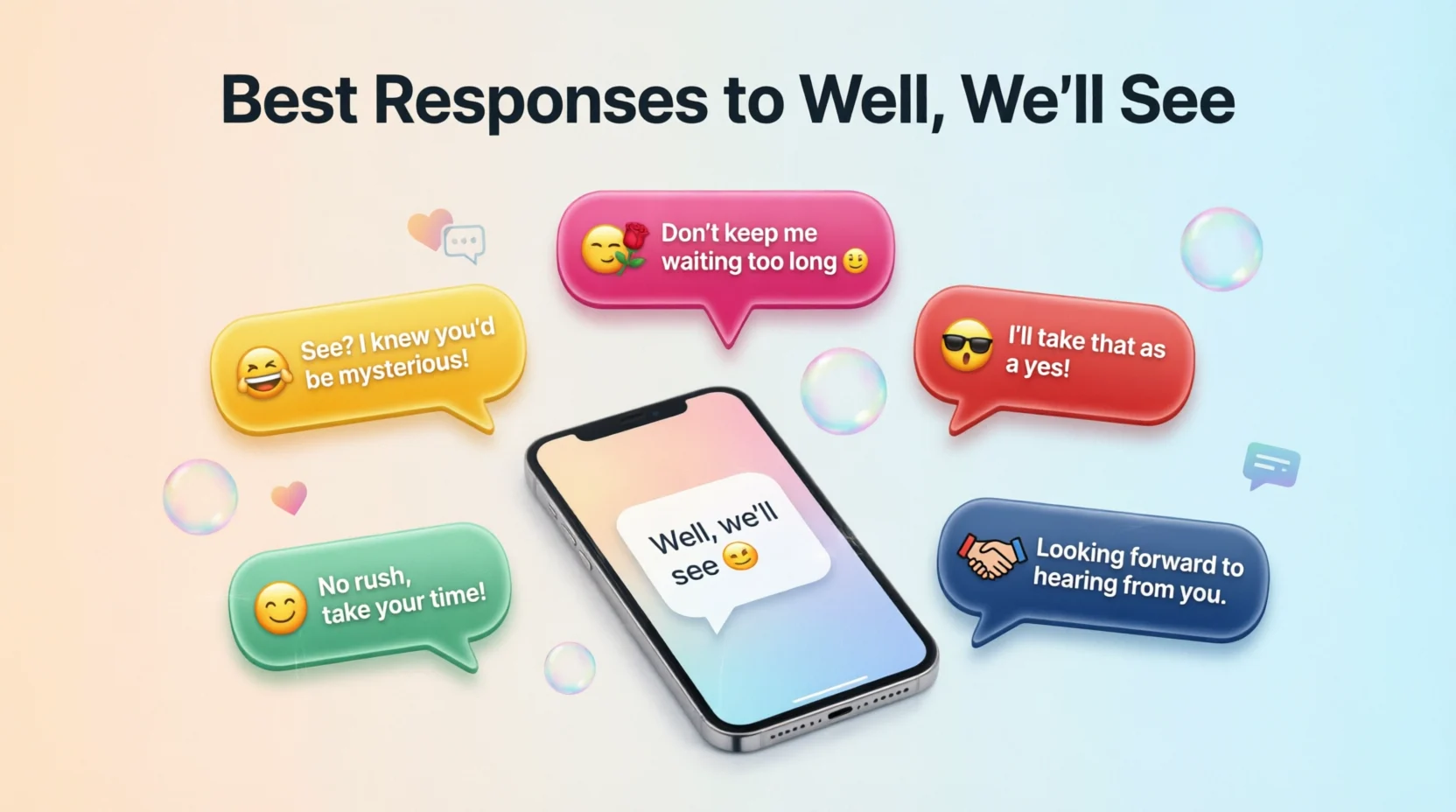
The best responses to “Well, we’ll see” depend on the situation and the tone you want to set. Whether you want to sound confident, funny, flirty, or professional, the right reply helps you keep your cool without sounding pushy.
Top replies: “Sounds good, let me know,” “I’ll take that as a maybe,” “No pressure, just keep me posted,” “I prefer a clear answer,” “Fair enough, time will tell.”
Ever asked someone a question and received the classic “Well, we’ll see”? Suddenly, you’re left wondering whether that’s a yes, a no, or just a polite way to avoid making a decision. It happens in text messages, DMs, workplace conversations, friendships, and even when you’re talking to your crush. And honestly, figuring out what to say next can feel harder than asking the original question.
The best responses to well see reply with confidence help you handle these moments without overthinking every word. Maybe you want to make someone laugh, flirt a little, sound professional, or show that you aren’t waiting around forever. Whatever your situation, your reply can communicate confidence without creating unnecessary pressure.
From witty comebacks to calm, mature responses, this list gives you plenty of ready-to-use options. Pick a reply that matches your personality, read the room, and remember that you don’t need to chase a definite answer from everyone.
1. Funny Responses to “Well, We’ll See”
Sometimes, humor is the easiest way to keep an uncertain answer from becoming awkward. These replies add a little personality without making the situation uncomfortable.
- I’ll keep my calendar emotionally available.
Example: When a friend is unsure about your weekend plans.
Meaning: You are jokingly showing that you’re open to the possibility. - Ah, the official answer of mystery.
Example: When someone gives you a vague reply about meeting up.
Meaning: You find their uncertainty amusing rather than frustrating. - Should I bring popcorn for the waiting period?
Example: When someone keeps delaying a decision.
Meaning: You are playfully pointing out how long the decision is taking. - I’ll consult the universe in the meantime.
Example: When a friend cannot confirm your plans.
Meaning: You are keeping the mood light while waiting. - My crystal ball says maybe.
Example: When someone responds vaguely to your invitation.
Meaning: You are humorously matching their uncertainty. - And the suspense continues!
Example: When a friend leaves your question unanswered.
Meaning: You are teasing them about the lack of a definite answer. - I’ll alert the committee of overthinkers.
Example: When you both joke about making simple decisions difficult.
Meaning: You are laughing at the uncertainty instead of stressing over it. - Not a yes, not a no, just a season finale.
Example: When someone leaves your plans hanging.
Meaning: You are treating the suspense like an entertaining story. - I’ll wait for the next episode.
Example: When a friend says they will decide later.
Meaning: You are playfully suggesting that their answer is still pending. - My patience has entered the chat.
Example: When someone needs extra time to decide.
Meaning: You are jokingly acknowledging the wait. - A plot twist would be appreciated.
Example: When a conversation has gone back and forth about plans.
Meaning: You are hoping for a more interesting outcome. - Okay, suspense champion, keep me updated.
Example: When a friend enjoys keeping plans uncertain.
Meaning: You are teasing them while remaining friendly.
2. Confident Responses to “Well, We’ll See”
Confidence means being comfortable with uncertainty without sacrificing your self-respect. These replies help you sound secure, independent, and composed.
- Sounds good, let me know when you’ve decided.
Example: When someone needs time to consider your invitation.
Meaning: You are confident enough to let them make their decision. - No worries, I’ll make my plans accordingly.
Example: When you need to organize your schedule.
Meaning: You are showing that your time matters too. - Fair enough, I’ll leave the decision with you.
Example: When someone is unsure about joining you.
Meaning: You respect their choice without taking responsibility for it. - I’m good either way.
Example: When you want to show that the outcome won’t upset you.
Meaning: You are comfortable with either possibility. - Let me know when you have a definite answer.
Example: When you need clarity before making arrangements.
Meaning: You value clear communication and practical decisions. - That’s fine, I’ll keep moving forward.
Example: When someone cannot commit to your suggestion.
Meaning: You are not putting your life on hold. - I appreciate a clear answer whenever you’re ready.
Example: When discussing an important decision.
Meaning: You prefer honesty and direct communication. - I’ll take that as a maybe for now.
Example: When someone gives you an uncertain response.
Meaning: You recognize that nothing has been confirmed. - No pressure, but I do value certainty.
Example: When you need to arrange plans in advance.
Meaning: You are expressing a preference without demanding an answer. - I’ll leave the ball in your court.
Example: When you’ve already made your suggestion.
Meaning: You are allowing the other person to take the next step. - That’s fine, I’ll focus on what I can control.
Example: When an outcome depends on another person’s decision.
Meaning: You are choosing to focus on your own actions. - Let me know if anything changes.
Example: When someone may or may not attend an event.
Meaning: You are keeping communication open without chasing them.
3. Sarcastic Responses to “Well, We’ll See”
A little sarcasm can make a vague answer more entertaining, especially when you already share a playful relationship. Keep it friendly so your reply doesn’t sound genuinely annoyed.
- Ah yes, the legendary maybe.
Example: When a friend avoids committing to plans.
Meaning: You are playfully highlighting their indecision. - I’ll mark it down as a professional mystery.
Example: When someone gives you a confusing answer.
Meaning: You are teasing them about being difficult to read. - Such a wonderfully specific answer.
Example: When you expected a definite yes or no.
Meaning: You are sarcastically pointing out the lack of detail. - Love the clarity. Truly inspirational.
Example: When someone responds vaguely to a simple question.
Meaning: You are humorously suggesting that their answer wasn’t helpful. - I’ll wait for the official announcement.
Example: When a friend acts as though a small decision needs a formal release.
Meaning: You are making light of the delay. - A decision may arrive by carrier pigeon.
Example: When someone takes a long time to respond.
Meaning: You are joking about how slowly the answer is coming. - The suspense is doing all the heavy lifting.
Example: When someone leaves your invitation unresolved.
Meaning: You are pointing out the uncertainty with dry humor. - I’ll try not to faint from all this certainty.
Example: When a friend gives you a particularly vague response.
Meaning: You are playfully exaggerating your reaction. - That answer deserves its own documentary.
Example: When someone repeatedly avoids giving a clear answer.
Meaning: You are teasing them about the mystery surrounding their decision. - I’ll alert the press when you decide.
Example: When a friend delays a small decision.
Meaning: You are joking about the importance of their eventual answer. - A masterclass in keeping options open.
Example: When someone refuses to commit to plans.
Meaning: You are lightly calling attention to their indecisiveness. - I’ll try to survive the suspense.
Example: When you want a playful reply to an uncertain message.
Meaning: You are exaggerating your impatience for comic effect.
4. Flirty Responses to “Well, We’ll See”
When your crush or someone special says “Well, we’ll see,” a little charm can keep the conversation going. These responses show interest without making the other person feel pressured.
- I’ll take that as a chance to impress you.
Example: When your crush is unsure about going on a date.
Meaning: You are showing interest with a confident touch of charm. - I’ll be looking forward to your verdict.
Example: When someone is considering spending time with you.
Meaning: You are expressing anticipation in a playful way. - Maybe I can make that a yes.
Example: When someone seems open to a flirty invitation.
Meaning: You are showing interest while leaving the choice to them. - I’ll let my charm do the waiting.
Example: When your crush playfully avoids giving an answer.
Meaning: You are keeping the interaction light and confident. - A maybe from you is still an interesting start.
Example: When you want to show that you are intrigued.
Meaning: You are treating their uncertain answer as an opening for more conversation. - I’ll save you a spot, just in case.
Example: When inviting someone special to an event.
Meaning: You are showing that you’d enjoy their company. - Guess I’ll have to make the plan tempting.
Example: When your crush isn’t sure about your invitation.
Meaning: You are being playful while showing enthusiasm. - I’ll be here, looking effortlessly hopeful.
Example: When you both enjoy lighthearted flirting.
Meaning: You are expressing interest with gentle humor. - You do enjoy keeping me curious, don’t you?
Example: When someone playfully leaves you guessing.
Meaning: You are inviting more flirtatious conversation. - I’ll consider that a cliffhanger.
Example: When a flirty conversation ends without a definite answer.
Meaning: You are teasing them about leaving the outcome open. - A yes would look good on this conversation.
Example: When asking someone to join you for coffee.
Meaning: You are hinting at your preference in a charming way. - No rush, I just think we’d have fun.
Example: When inviting someone on a casual date.
Meaning: You are expressing genuine interest without applying pressure.
5. Polite Responses to “Well, We’ll See”
Polite replies are ideal when you want to maintain a positive atmosphere and give the other person room to decide.
- Of course, take your time.
Example: When a friend needs time to consider your suggestion.
Meaning: You are being patient and respectful. - That works for me, just keep me posted.
Example: When coordinating a casual get-together.
Meaning: You are keeping communication open. - Absolutely, let me know when you can.
Example: When waiting for confirmation about an event.
Meaning: You are asking for an update without sounding demanding. - No problem at all.
Example: When someone cannot give you an immediate answer.
Meaning: You are showing that the uncertainty is acceptable. - I understand, thanks for considering it.
Example: When someone is thinking about your invitation.
Meaning: You appreciate their willingness to consider your request. - That’s perfectly fine with me.
Example: When discussing flexible arrangements.
Meaning: You are accepting the situation graciously. - Whenever you know, feel free to let me know.
Example: When waiting for a friend to confirm plans.
Meaning: You are giving them space to respond later. - I appreciate you keeping me updated.
Example: When someone is still checking their availability.
Meaning: You value communication and consideration. - Let’s see how things work out.
Example: When the outcome depends on several factors.
Meaning: You are remaining open-minded. - Thanks, I appreciate your honesty.
Example: When someone admits they aren’t sure.
Meaning: You are encouraging honest communication. - That’s understandable.
Example: When someone has other commitments to consider.
Meaning: You are acknowledging their situation without judgment. - I’ll look forward to hearing from you.
Example: When awaiting a response about an invitation.
Meaning: You are politely expressing interest in a future update.
6. Professional Responses to “Well, We’ll See”
At work, vague answers can affect deadlines, meetings, and project planning. These professional responses help you seek clarity without sounding confrontational.
- Understood. Please let me know once a decision is made.
Example: When a manager is considering your proposal.
Meaning: You are acknowledging the response while requesting a future update. - Thank you. I’ll plan around the current timeline for now.
Example: When a project deadline is still uncertain.
Meaning: You are maintaining a practical approach to planning. - Would it be helpful to revisit this next week?
Example: When a colleague cannot decide immediately.
Meaning: You are suggesting a clear next step. - I understand. Is there a date when we can confirm?
Example: When you need an answer before scheduling work.
Meaning: You are asking for a reasonable decision timeline. - I’ll keep the option open until we have confirmation.
Example: When discussing a possible project arrangement.
Meaning: You are staying flexible without treating the plan as final. - Please keep me informed of any updates.
Example: When waiting for approval from a team member.
Meaning: You want to remain informed about progress. - That makes sense. I’ll prepare for both possibilities.
Example: When planning depends on an uncertain decision.
Meaning: You are demonstrating flexibility and foresight. - Would you prefer that I follow up later?
Example: When someone needs additional time to review a request.
Meaning: You are clarifying the best way to continue communication. - I’ll proceed with the confirmed priorities in the meantime.
Example: When another task depends on an unresolved decision.
Meaning: You are keeping work moving forward. - Could you share what factors are still being considered?
Example: When you need to understand a pending business decision.
Meaning: You are seeking useful context rather than demanding an answer. - Thank you. I’ll wait for your confirmation before proceeding.
Example: When you need formal approval to move ahead.
Meaning: You are respecting the decision-making process. - Let’s agree on a follow-up date to keep things on track.
Example: When a team needs a decision to meet a deadline.
Meaning: You are encouraging accountability and organization.
7. Short and Direct Responses to “Well, We’ll See”
Sometimes the best response is short, simple, and easy to send. These options work well when you don’t want to overexplain.
- Sounds good.
Example: When the matter isn’t particularly important.
Meaning: You are acknowledging their response without adding pressure. - Fair enough.
Example: When you accept that the decision remains open.
Meaning: You are showing calm acceptance. - Keep me posted.
Example: When you want an update later.
Meaning: You are inviting further communication. - We’ll see!
Example: When you want to mirror their relaxed tone.
Meaning: You are leaving the outcome open too. - All good.
Example: When you’re comfortable with the uncertainty.
Meaning: You are communicating that there is no immediate problem. - Let me know.
Example: When you need the other person to contact you later.
Meaning: You are putting the next step in their hands. - No worries.
Example: When a friend cannot confirm plans.
Meaning: You are keeping things relaxed. - That’s fine.
Example: When you accept their need for more time.
Meaning: You are expressing straightforward acceptance. - We’ll figure it out.
Example: When making flexible plans with someone you trust.
Meaning: You are staying optimistic about finding a solution. - Okay, noted.
Example: When acknowledging a response in a practical conversation.
Meaning: You are confirming that you understand. - Whenever you’re ready.
Example: When someone needs time to make a choice.
Meaning: You are showing patience. - Time will tell.
Example: When neither person can predict the outcome.
Meaning: You are accepting that the answer will become clear later.
8. Witty Responses to “Well, We’ll See”
A clever reply adds personality while showing that you understood the uncertainty. These lines are great for friends, casual chats, and playful exchanges.
- Maybe is the waiting room of yes and no.
Example: When someone gives you an uncertain answer.
Meaning: You are cleverly describing the middle ground between two choices. - I’ll keep the possibility on the table.
Example: When discussing plans that aren’t confirmed.
Meaning: You are staying open to the idea without making assumptions. - Let’s let the future do the talking.
Example: When the outcome depends on what happens next.
Meaning: You are choosing patience over speculation. - A little clarity never hurt anyone.
Example: When you want a more direct answer.
Meaning: You are gently encouraging clearer communication. - I’ll consider the case still under review.
Example: When someone is deciding whether to accept your suggestion.
Meaning: You are using playful formal language to describe the delay. - Possibility accepted, certainty pending.
Example: When responding to an unresolved invitation.
Meaning: You understand that the idea remains possible but unconfirmed. - I’ll leave room for a pleasant surprise.
Example: When you hope someone will agree to your plans.
Meaning: You are remaining optimistic without expecting a particular outcome. - Let’s keep the door open, not the clock stopped.
Example: When you’re open to an idea but have other plans.
Meaning: You are showing flexibility while respecting your time. - The answer is still buffering, I see.
Example: When a friend takes a while to decide.
Meaning: You are comparing their indecision to a slow internet connection. - I’ll file that under possibilities.
Example: When you need to acknowledge a tentative plan.
Meaning: You are treating the suggestion as an option rather than a promise. - We’ll let the evidence arrive.
Example: When you cannot predict how something will turn out.
Meaning: You prefer to wait for facts instead of making assumptions. - For now, the mystery remains unsolved.
Example: When you want to end an uncertain conversation playfully.
Meaning: You are acknowledging that the decision is still unknown.
9. Sweet Responses to “Well, We’ll See”
Sweet responses are perfect for people you care about. They show patience and kindness while keeping the connection warm.
- That’s okay, I’d just be happy if it works out.
Example: When inviting a friend to spend time together.
Meaning: You are expressing hope without creating pressure. - Take your time, there’s no rush.
Example: When someone needs to think things over.
Meaning: You want them to feel comfortable making their choice. - Hopefully, we get to make it happen.
Example: When discussing a plan you both might enjoy.
Meaning: You are sharing optimism about the possibility. - I’d love it if things worked out.
Example: When hoping to see someone soon.
Meaning: You are expressing genuine enthusiasm. - Whatever happens, I hope your day goes well.
Example: When ending a conversation on a kind note.
Meaning: You are showing goodwill regardless of the outcome. - Let’s hope for the best.
Example: When the situation is outside your control.
Meaning: You are choosing an optimistic outlook. - It would be lovely if we could make it happen.
Example: When discussing a future visit or gathering.
Meaning: You are communicating warm interest. - No pressure, just sending good wishes.
Example: When someone seems uncertain about a decision.
Meaning: You are offering kindness without demanding agreement. - I’ll be happy either way, but I’m hopeful.
Example: When you want to be honest about your feelings.
Meaning: You are balancing acceptance with optimism. - Let’s see what good things come our way.
Example: When you want to keep the conversation positive.
Meaning: You are approaching the future with hope. - I appreciate you considering it.
Example: When someone is thinking about your invitation.
Meaning: You are showing gratitude for their consideration. - Fingers crossed for a happy yes!
Example: When a friend is deciding whether to join your plans.
Meaning: You are playfully expressing your preference for a positive outcome.
10. Chill and Casual Responses to “Well, We’ll See”
Not every conversation needs a clever comeback. These relaxed responses work when you want to keep things easygoing and avoid overthinking.
- Yeah, let’s see how it goes.
Example: When discussing a plan that depends on timing.
Meaning: You are comfortable letting things unfold naturally. - Cool, just let me know.
Example: When a friend is unsure about meeting up.
Meaning: You are keeping the conversation simple and friendly. - Works for me.
Example: When you’re flexible about the outcome.
Meaning: You are showing that you don’t need an immediate decision. - We’ll play it by ear.
Example: When making informal plans.
Meaning: You are happy to decide closer to the time. - No big deal either way.
Example: When the outcome won’t affect your plans much.
Meaning: You are showing that you’re relaxed about the result. - Let’s see what happens.
Example: When neither person knows what the future holds.
Meaning: You are accepting the uncertainty. - All right, keep me in the loop.
Example: When someone may have an update later.
Meaning: You are asking to stay informed in a casual way. - Bet, we’ll figure it out.
Example: When talking with a friend who uses casual slang.
Meaning: You are expressing confidence that you’ll find a solution. - Okay, we’ll sort it out later.
Example: When there’s no need to decide immediately.
Meaning: You are postponing the decision without making it a problem. - Sure thing, no stress.
Example: When you want to reassure someone who feels uncertain.
Meaning: You are keeping the interaction comfortable. - Let’s keep it flexible.
Example: When coordinating plans with busy friends.
Meaning: You are allowing room for changes. - Sounds like a plan, for now.
Example: When you have a tentative arrangement.
Meaning: You are acknowledging the idea without treating it as final.
11. Boundary-Setting Responses to “Well, We’ll See”
Sometimes uncertainty affects your schedule, emotions, or important decisions. These replies help you express your needs without being rude.
- That’s fine, but I need to plan ahead.
Example: When arranging travel or an event.
Meaning: You are explaining why a timely answer matters. - Let me know by Friday so I can organize things.
Example: When waiting for confirmation about weekend plans.
Meaning: You are setting a reasonable deadline. - I understand, but I’ll need a definite answer before committing.
Example: When making arrangements that require your own commitment.
Meaning: You are protecting yourself from unnecessary uncertainty. - If you’re unsure, I’ll make other plans for now.
Example: When you don’t want to keep your schedule open indefinitely.
Meaning: You are prioritizing your time without being hostile. - I’m happy to consider it when you’re ready to decide.
Example: When someone is undecided about a shared plan.
Meaning: You remain open while leaving the responsibility with them. - I’d rather not leave everything up in the air.
Example: When uncertainty is affecting an important arrangement.
Meaning: You prefer a more settled plan. - Let’s revisit this when we both have more clarity.
Example: When neither person has enough information to decide.
Meaning: You are suggesting a better time for the discussion. - I respect your uncertainty, and I need to respect my time too.
Example: When someone repeatedly delays confirming plans.
Meaning: You are balancing understanding with self-respect. - It’s okay to say no if that’s your answer.
Example: When you sense that someone is avoiding a direct response.
Meaning: You are making honesty feel safer than avoidance. - I’ll keep moving forward rather than wait indefinitely.
Example: When a decision affects your next steps.
Meaning: You are choosing progress over prolonged uncertainty. - Please let me know when you can give a clear answer.
Example: When a decision needs to be finalized.
Meaning: You are requesting clarity in a respectful manner. - I’m open to it, but I won’t assume it’s confirmed.
Example: When someone suggests a possible future arrangement.
Meaning: You are keeping expectations realistic.
12. Emotional Responses to “Well, We’ll See”
When a situation matters to you, a vague response can feel disappointing. These replies help you communicate your feelings honestly without assuming the other person’s intentions.
- I was hoping for a more definite answer, honestly.
Example: When you were excited about a plan.
Meaning: You are gently expressing disappointment. - I understand, I just wanted to know where we stand.
Example: When discussing an important personal decision.
Meaning: You are seeking clarity and emotional reassurance. - It’s okay to be unsure, just be honest with me.
Example: When talking about a sensitive subject.
Meaning: You value honesty more than a forced answer. - I care about this, so the uncertainty is difficult for me.
Example: When a decision has personal significance.
Meaning: You are explaining why the outcome matters emotionally. - I’d rather hear the truth than keep guessing.
Example: When someone’s response leaves you confused.
Meaning: You prefer direct communication over speculation. - I can wait, but I need to understand what we’re waiting for.
Example: When a decision has been postponed several times.
Meaning: You want patience to come with some clarity. - I hope it works out, but I don’t want to assume.
Example: When you feel optimistic but uncertain.
Meaning: You are acknowledging your hopes while staying realistic. - Thanks for being honest about not knowing yet.
Example: When someone openly admits their uncertainty.
Meaning: You appreciate their willingness to be truthful. - I’d love a clear answer when you’re ready to give one.
Example: When the situation matters to you personally.
Meaning: You are expressing a need for clarity without rushing them. - I don’t want to pressure you, but I do want to understand.
Example: When discussing an uncertain relationship or friendship.
Meaning: You are balancing respect for their space with your own need for answers. - Let’s talk again when you’ve had time to think.
Example: When emotions are high and a decision can wait.
Meaning: You are creating space for a more thoughtful conversation. - Whatever your answer is, I’d appreciate honesty.
Example: When you are waiting for an important response.
Meaning: You are prioritizing sincerity over a particular outcome.
13. Playful and Dramatic Responses to “Well, We’ll See”
For conversations where everyone enjoys a little theatrical humor, these replies make the suspense part of the fun.
- And so, the waiting begins.
Example: When a friend leaves your invitation unanswered.
Meaning: You are dramatically acknowledging the delay. - I’ll be awaiting the grand announcement.
Example: When someone treats a small decision like a major event.
Meaning: You are playfully exaggerating the importance of their answer. - Cue the dramatic background music.
Example: When the conversation feels like a cliffhanger.
Meaning: You are turning uncertainty into a funny moment. - The audience demands an answer!
Example: When your friend jokes around instead of deciding.
Meaning: You are teasing them in an exaggerated way. - To be continued, apparently.
Example: When a conversation ends without a decision.
Meaning: You are comparing the situation to an unfinished story. - I’ll prepare for every possible plot twist.
Example: When plans could go in several directions.
Meaning: You are humorously acknowledging the unpredictability. - The suspense deserves an award.
Example: When someone takes their time making a decision.
Meaning: You are exaggerating how dramatic the wait feels. - And now we enter the maybe era.
Example: When someone is unsure about your suggestion.
Meaning: You are turning their uncertainty into a playful running joke. - I’ll be here for the season finale.
Example: When a friend keeps postponing their answer.
Meaning: You are comparing the decision to a dramatic television series. - What a breathtaking cliffhanger.
Example: When you want to tease someone about their vague answer.
Meaning: You are using exaggerated praise to make the uncertainty funny. - Let destiny submit its final decision.
Example: When neither person can influence the outcome.
Meaning: You are playfully handing the matter over to fate. - Until then, I’ll remain dramatically undecided too.
Example: When you want to match a friend’s theatrical tone.
Meaning: You are joining in the joke rather than demanding an answer.
14. Mature and Respectful Responses to “Well, We’ll See”
A mature reply recognizes that people need time to think. These responses encourage mutual understanding and constructive communication.
- I understand that you need time to decide.
Example: When someone is considering a meaningful request.
Meaning: You are acknowledging their need for reflection. - Let’s give it some thought and talk again later.
Example: When a decision deserves careful consideration.
Meaning: You are encouraging a thoughtful conversation rather than rushing. - I respect that, and I’m open to discussing it again.
Example: When someone isn’t ready to make a commitment.
Meaning: You are showing respect while keeping communication open. - It’s okay if you need more information first.
Example: When someone is unsure about a proposal.
Meaning: You are making room for informed decision-making. - Let’s focus on what we know for now.
Example: When uncertainty is creating confusion.
Meaning: You are encouraging a practical, grounded approach. - I’d rather we both feel comfortable with the decision.
Example: When making plans with a friend or partner.
Meaning: You value mutual agreement over a rushed answer. - We can revisit this when the timing is better.
Example: When current circumstances make a decision difficult.
Meaning: You are allowing space for a more suitable moment. - Thanks for being upfront about your uncertainty.
Example: When someone openly says they haven’t decided.
Meaning: You appreciate their transparency. - Let’s make sure we’re both on the same page.
Example: When discussing shared responsibilities or plans.
Meaning: You want clear expectations before moving forward. - I don’t expect an immediate answer, just honest communication.
Example: When a decision is important but not urgent.
Meaning: You are emphasizing honesty without demanding speed. - We can take it one step at a time.
Example: When the situation feels complicated.
Meaning: You prefer steady progress over unnecessary pressure. - Whatever we decide, let’s communicate clearly.
Example: When coordinating a shared plan or responsibility.
Meaning: You want the process to remain respectful and transparent.
15. Clever Responses When You Want a Clear Yes or No
If you need a definite answer, you can ask for one without sounding rude. These responses are especially useful when plans, deadlines, or expectations depend on the decision.
- Should I treat that as a maybe for now?
Example: When you need to understand whether an invitation is still possible.
Meaning: You are asking for clarification without making assumptions. - What would help you make a decision?
Example: When someone seems interested but uncertain.
Meaning: You are inviting them to explain what they need. - Is there anything you’re waiting to find out first?
Example: When a decision depends on missing information.
Meaning: You are trying to understand the reason for the delay. - Would a quick yes or no make things easier?
Example: When the conversation has become unnecessarily complicated.
Meaning: You are suggesting a straightforward way to resolve uncertainty. - When do you think you’ll know for sure?
Example: When planning around another person’s availability.
Meaning: You are requesting a realistic timeline. - Is this a genuine possibility or just a polite maybe?
Example: When you aren’t sure how seriously to take the response.
Meaning: You are asking for honesty about their level of interest. - What are the chances, realistically?
Example: When you want to understand how likely a plan is to happen.
Meaning: You are inviting a practical assessment of the situation. - Would you prefer to decide now or check back later?
Example: When someone needs more time to think.
Meaning: You are offering two clear ways to move forward. - I can work with either answer; I just need to know.
Example: When making plans that depend on a definite response.
Meaning: You are prioritizing clarity rather than trying to control the outcome. - Let’s set a time to make the final call.
Example: When an event or arrangement needs confirmation.
Meaning: You are turning an open-ended decision into a manageable next step. - Would it be better to make another plan?
Example: When the current arrangement seems unlikely to happen.
Meaning: You are checking whether you should explore alternatives. - No pressure, just help me plan realistically.
Example: When you need to organize your time around an uncertain answer.
Meaning: You are explaining your practical need for clarity without being demanding.
FAQs
What Does “Well, We’ll See” Mean?
It usually means the person hasn’t decided yet, though context and tone can suggest hesitation or uncertainty.
Is “Well, We’ll See” a Polite Way to Say No?
Sometimes, but not always. The person may genuinely need more time before deciding.
What Is the Best Response to “Well, We’ll See”?
Try “Sounds good, let me know when you’ve decided.” It is calm, confident, and respectful.
How Do You Reply to “Well, We’ll See” From Your Crush?
Try “No rush, I just think we’d have fun.” It shows interest without putting pressure on them.
Can “Well, We’ll See” Be Flirty?
Yes. Depending on the context, it can be playful or teasing, but it doesn’t automatically mean romantic interest.
How Do You Respond Professionally to “Well, We’ll See”?
Say “Understood. When would be a good time to confirm?” to keep expectations and deadlines clear.
What If You Don’t Actually Mean “Well, We’ll See”?
Be honest instead. Say “I don’t think it’ll work for me, but thank you for asking.”
Is Humor Appropriate When Someone Says “Well, We’ll See”?
Yes, if you share a playful rapport. Use a straightforward response when the decision is sensitive or important.
Should You Keep Asking for an Answer?
Ask once for clarification, then give the person reasonable space to decide. Follow up if necessary.
Does “Well, We’ll See” Mean Someone Is Not Interested?
Not necessarily. Look at their overall communication and actions rather than interpreting one phrase alone.
Conclusion
Knowing how to respond to “Well, we’ll see” can make everyday conversations easier, whether you’re texting a crush, organizing plans with friends, or discussing something important at work. The best response isn’t always the funniest or cleverest one. Sometimes, a simple acknowledgment works best; other times, a confident question helps you get the clarity you need.
Remember, you can be playful without being rude, interested without being pushy, and patient without putting your life on hold. Choose a reply that fits your personality and the situation. Save your favorite lines, share this list with a friend who overthinks every text, and try a new response the next time someone leaves you guessing. Confidence looks good in every conversation.