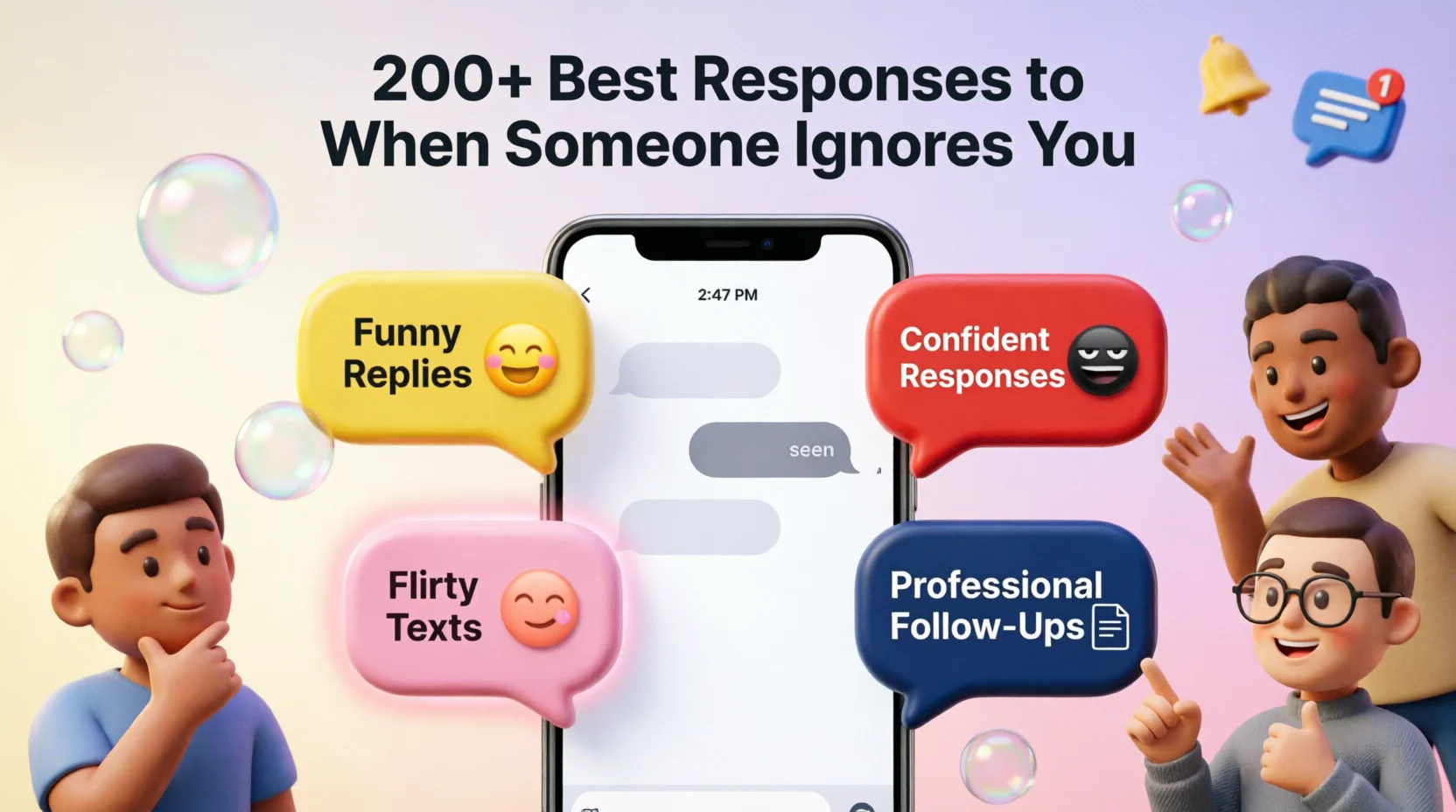
The best responses to when someone ignores you depend on your relationship, the situation, and how you feel. You can keep things funny, show confidence, set boundaries, or express your feelings without sounding desperate.
Top responses: “Everything okay?”, “I’ll give you space,” “Guess you’re busy!”, “I match energy, not excuses,” “Let me know when you’re ready to talk.”
Ever sent a message, watched it get delivered, and then waited so long for a reply that you started questioning your entire conversation history? We’ve all been there! Whether it’s a friend leaving you on read, a crush suddenly going silent, a partner acting distant, or a coworker ignoring your message, being ignored can feel awkward and frustrating.
Finding the best responses to when someone ignores you isn’t about winning an argument or making someone feel guilty. It’s about choosing words that reflect your personality while protecting your peace. Sometimes, a little humor breaks the tension. Other times, a confident one-liner or an honest message says everything that needs to be said.
The trick is knowing when to joke, when to communicate directly, and when to stop chasing a response. Here are 200+ ready-to-use replies for every mood, relationship, and situation, from playful texts to professional messages.
1. Funny Responses to When Someone Ignores You
Use these playful replies when you want to lighten the mood without turning a delayed response into a serious argument.
- “Did your keyboard go on vacation?”
Example: When a friend disappears halfway through a casual chat.
Meaning: You’re joking about their sudden silence. - “Hello? Is this number still in service?”
Example: When your friend hasn’t replied to your last few messages.
Meaning: You’re playfully checking whether they’re available. - “I think my message got lost in another dimension.”
Example: When a harmless text goes unanswered for hours.
Meaning: You’re making the silence feel less awkward with humor. - “Should I send a search party?”
Example: When your usually talkative friend goes quiet.
Meaning: You’re showing concern in a funny way. - “Your reply is taking the scenic route.”
Example: When someone takes much longer than expected to respond.
Meaning: You’re teasing them about their delayed reply. - “Did my message arrive by carrier pigeon?”
Example: When you want to joke about slow communication.
Meaning: You’re playfully exaggerating how long you’ve waited. - “Breaking news: My text remains unanswered.”
Example: When joking with a close friend who regularly replies late.
Meaning: You’re turning the situation into a mock news report. - “I hope my message didn’t scare your phone.”
Example: When someone suddenly stops responding to a friendly conversation.
Meaning: You’re teasing them without making a serious accusation. - “Should I book an appointment for your reply?”
Example: When a friend takes forever to answer a simple question.
Meaning: You’re joking that their response requires scheduling. - “Your silence deserves its own podcast.”
Example: When someone has been unusually quiet in your chat.
Meaning: You’re highlighting their silence with playful exaggeration. - “I see we’re communicating through invisible signals now.”
Example: When a friend reads your message but doesn’t respond.
Meaning: You’re joking about the lack of communication. - “At this point, even my notifications have given up.”
Example: When you’ve waited a long time for a reply.
Meaning: You’re expressing mild frustration in a humorous way.
2. Confident Responses to When Someone Ignores You
These replies communicate self-respect without begging for attention or trying to prove your worth.
- “I’ll leave the conversation here for now.”
Example: When someone repeatedly avoids responding to your messages.
Meaning: You’re stepping back without creating unnecessary conflict. - “I’m happy to talk when you’re ready.”
Example: When someone needs space but hasn’t explained why.
Meaning: You’re available without pressuring them. - “I value communication that goes both ways.”
Example: When a friendship feels increasingly one-sided.
Meaning: You’re expressing a reasonable expectation of mutual effort. - “I’ll respect your space and focus on mine.”
Example: When someone seems distant and you want to stop pushing.
Meaning: You’re choosing balance instead of chasing a response. - “No pressure. I’ll let you reach out when you’re ready.”
Example: When you’ve already tried to start a conversation.
Meaning: You’re giving them room to respond independently. - “I don’t need an instant reply, just honest communication.”
Example: When someone misunderstands your expectations about texting.
Meaning: You’re distinguishing patience from accepting ongoing uncertainty. - “I’ll take a step back for now.”
Example: When repeated attempts to connect aren’t working.
Meaning: You’re protecting your energy without making a dramatic exit. - “My time matters, and so does yours.”
Example: When you want to establish healthier communication habits.
Meaning: You’re acknowledging that both people’s time deserves respect. - “I’m not going to force a conversation.”
Example: When someone appears unwilling to engage.
Meaning: You’re accepting their choice instead of pushing for attention. - “When communication feels mutual, I’m all in.”
Example: When explaining what you want from a friendship or relationship.
Meaning: You’re expressing openness alongside a clear boundary. - “I’ll focus on what I can control.”
Example: When you’re tempted to keep checking your phone.
Meaning: You’re redirecting your attention toward yourself. - “I’m open to talking, but I won’t keep pushing.”
Example: When you’ve reached out several times without a response.
Meaning: You’re leaving the door open while respecting your limits.
3. Sarcastic Responses to When Someone Ignores You
Choose these witty lines when the relationship allows playful sarcasm and the situation isn’t especially sensitive.
- “Wow, what a detailed response!”
Example: When someone replies with silence after a long message.
Meaning: You’re sarcastically pointing out their lack of response. - “Your communication skills are truly mysterious.”
Example: When a friend repeatedly disappears during conversations.
Meaning: You’re teasing them about their inconsistent communication. - “Silence noted and filed accordingly.”
Example: When someone leaves a casual question unanswered.
Meaning: You’re making a playful comment about their silence. - “I appreciate your very quiet contribution.”
Example: When someone doesn’t respond to a group discussion.
Meaning: You’re highlighting their absence with dry humor. - “That reply must be exclusive because I can’t see it.”
Example: When someone says they replied but you haven’t received anything.
Meaning: You’re joking about the missing message. - “Your inbox must be a very demanding place.”
Example: When a friend regularly takes ages to answer.
Meaning: You’re sarcastically suggesting they’re overwhelmed with messages. - “A masterpiece of noncommunication.”
Example: When someone avoids answering a straightforward question.
Meaning: You’re humorously criticizing the lack of communication. - “I see your silence is working overtime.”
Example: When someone has been unusually quiet in your chat.
Meaning: You’re exaggerating their silence for comic effect. - “Five stars for consistency in disappearing.”
Example: When someone repeatedly vanishes from conversations.
Meaning: You’re teasing them about an established habit. - “Your reply is apparently a limited edition.”
Example: When you rarely receive messages from a particular friend.
Meaning: You’re joking about how uncommon their replies are. - “Communication really isn’t your favorite hobby, is it?”
Example: When someone consistently avoids casual conversations.
Meaning: You’re pointing out their communication style with mild sarcasm. - “I’ll alert the media when you respond.”
Example: When teasing someone who takes a long time to text back.
Meaning: You’re making their eventual response sound like major news.
4. Polite Responses to When Someone Ignores You
These considerate replies work when you want to follow up without sounding impatient or confrontational.
- “Hey, just checking whether you saw my message.”
Example: When you need an answer to a previous question.
Meaning: You’re following up in a friendly, straightforward way. - “No worries if you’re busy. Reply when you can.”
Example: When messaging a friend with a demanding schedule.
Meaning: You’re showing patience and understanding. - “I wanted to make sure everything is okay.”
Example: When someone who usually responds goes quiet unexpectedly.
Meaning: You’re expressing genuine concern. - “Whenever you have a moment, I’d appreciate your reply.”
Example: When following up about a nonurgent plan.
Meaning: You’re politely communicating that a response would help. - “Just following up on my earlier message.”
Example: When checking on an unanswered request.
Meaning: You’re keeping the conversation professional and clear. - “Let me know if now isn’t a good time to talk.”
Example: When someone seems unavailable for a conversation.
Meaning: You’re giving them an easy way to communicate their needs. - “I understand you may have a lot going on.”
Example: When a friend is dealing with a busy week.
Meaning: You’re acknowledging their possible circumstances. - “I’d be happy to reconnect whenever it works for you.”
Example: When an acquaintance hasn’t answered an invitation.
Meaning: You’re expressing interest without applying pressure. - “Please let me know if you need more time.”
Example: When waiting for someone’s decision.
Meaning: You’re making room for an honest update. - “I hope everything is going well on your side.”
Example: When checking in after a period of silence.
Meaning: You’re opening the door to a friendly conversation. - “Could you update me when you get a chance?”
Example: When you need information to plan your next steps.
Meaning: You’re requesting a response respectfully. - “Thanks for getting back to me whenever you’re able.”
Example: When you want to keep a follow-up warm and courteous.
Meaning: You’re emphasizing cooperation rather than blame.
5. Professional Responses to When Someone Ignores You
At work, keep your replies focused on deadlines, decisions, and next steps rather than personal frustration.
- “Following up to see whether you’ve had a chance to review this.”
Example: When a colleague hasn’t reviewed a shared document.
Meaning: You’re requesting an update professionally. - “Could you confirm receipt of my previous email?”
Example: When you need confirmation that an important email arrived.
Meaning: You’re checking delivery without assuming intentional avoidance. - “I’d appreciate your feedback when convenient.”
Example: When waiting for comments on a work assignment.
Meaning: You’re politely asking for input. - “Please let me know if additional information is needed.”
Example: When a request has received no response.
Meaning: You’re offering help to move the task forward. - “I’m checking in regarding the status of this request.”
Example: When following up on an outstanding workplace issue.
Meaning: You’re seeking a clear progress update. - “To keep things moving, could you share an update by Friday?”
Example: When a project has an approaching deadline.
Meaning: You’re establishing a practical timeframe. - “Please advise on the next steps when possible.”
Example: When you cannot proceed without a decision.
Meaning: You’re requesting guidance in a formal tone. - “I’ll proceed with the available information unless I hear otherwise.”
Example: When a deadline requires you to continue without feedback.
Meaning: You’re communicating a reasonable plan and expectation. - “Could we schedule a brief check-in to resolve this?”
Example: When multiple messages haven’t clarified a work issue.
Meaning: You’re suggesting a more effective communication method. - “I’m happy to discuss this at a time that suits you.”
Example: When a manager or teammate seems unavailable.
Meaning: You’re remaining flexible and cooperative. - “Please confirm whether this timeline still works for you.”
Example: When waiting for approval on a shared schedule.
Meaning: You’re asking for a specific decision. - “I’ll follow up again if I haven’t received an update.”
Example: When an outstanding request needs further attention.
Meaning: You’re setting a clear expectation for continued communication.
6. Flirty Responses to When Someone Ignores You
If the silence feels playful and the other person has shown mutual interest, these replies can add charm without creating pressure.
- “Trying to make me miss you already?”
Example: When your crush playfully disappears from a conversation.
Meaning: You’re teasing them while showing a little interest. - “I was enjoying our conversation, you know.”
Example: When a promising chat suddenly goes quiet.
Meaning: You’re letting them know you liked talking to them. - “Should I save my best jokes for your return?”
Example: When a playful exchange pauses unexpectedly.
Meaning: You’re inviting them to continue the fun. - “You disappeared right when things got interesting.”
Example: When a flirty conversation stops mid-topic.
Meaning: You’re expressing curiosity and encouraging a reply. - “I’ll forgive the late reply if you have a good story.”
Example: When someone returns after a long texting break.
Meaning: You’re playfully inviting an explanation. - “Was my charm too much for your notifications?”
Example: When you already have a comfortable, teasing dynamic.
Meaning: You’re jokingly suggesting you made an impression. - “I hope your day is as interesting as our chat was.”
Example: When you want to restart a conversation warmly.
Meaning: You’re showing interest without demanding attention. - “Come back, I haven’t finished teasing you.”
Example: When a mutual flirtation pauses unexpectedly.
Meaning: You’re expressing a playful desire to continue chatting. - “I’ll pretend you were thinking of the perfect reply.”
Example: When a crush takes a while to answer a joke.
Meaning: You’re giving them a humorous excuse to rejoin the chat. - “Your turn to keep this conversation interesting.”
Example: When you want the other person to participate more.
Meaning: You’re playfully encouraging equal effort. - “I was about to send a very dramatic missing-person report.”
Example: When someone returns after a noticeable absence.
Meaning: You’re making their silence into a lighthearted joke. - “Well, look who’s making a comeback.”
Example: When your crush finally replies after a long pause.
Meaning: You’re greeting their return with playful enthusiasm.
7. Cute Responses to When Someone Ignores You
These sweet, lighthearted lines are ideal for close friends or people who appreciate affectionate teasing.
- “Hellooo, little disappearing act!”
Example: When your best friend forgets to reply to a casual message.
Meaning: You’re calling them back into the conversation affectionately. - “Sending a tiny reminder that I exist.”
Example: When you want to follow up without sounding annoyed.
Meaning: You’re gently asking for their attention. - “Your favorite notification is waiting for you.”
Example: When teasing someone who enjoys your messages.
Meaning: You’re playfully presenting yourself as a welcome interruption. - “I miss our little chats.”
Example: When a close friend has been quiet lately.
Meaning: You’re honestly expressing that you miss connecting. - “Come back when you can. I’ve got stories!”
Example: When you have updates to share with a friend.
Meaning: You’re inviting them to reconnect enthusiastically. - “Just leaving a little hello here.”
Example: When checking in after a short silence.
Meaning: You’re showing warmth without asking for an explanation. - “Your chat feels a little too quiet today.”
Example: When someone you regularly talk to hasn’t appeared online.
Meaning: You’re letting them know you notice their absence. - “A little reply would make me smile.”
Example: When you want a friendly response from someone close.
Meaning: You’re sharing a simple wish without making demands. - “Hope you’re having a lovely day, wherever you are.”
Example: When checking in on a friend who’s been busy.
Meaning: You’re expressing care regardless of their response time. - “Leaving some good vibes in your inbox.”
Example: When you want to brighten someone’s day.
Meaning: You’re offering positivity without expecting an immediate reply. - “I’ll be here when you’re ready for a catch-up.”
Example: When a friend needs time away from their phone.
Meaning: You’re showing patience and continued affection. - “Our next chat better come with extra stories.”
Example: When joking with a friend after a quiet spell.
Meaning: You’re looking forward to reconnecting.
8. Brutally Honest Responses to When Someone Ignores You
These direct responses are useful when silence has become a repeated pattern and you need to communicate clearly.
- “If you don’t want to talk, you can tell me.”
Example: When someone repeatedly avoids an important conversation.
Meaning: You’re asking for honesty instead of guessing. - “I’d rather hear the truth than keep wondering.”
Example: When uncertainty about a relationship is bothering you.
Meaning: You’re prioritizing clarity over speculation. - “I’m not sure where we stand, and I’d like to know.”
Example: When a close connection suddenly becomes distant.
Meaning: You’re asking for a straightforward understanding of the relationship. - “I’ve reached out a few times, so I’ll leave it here.”
Example: When you’ve already sent several unanswered messages.
Meaning: You’re ending the cycle of repeated follow-ups. - “Communication matters to me, even when the answer is difficult.”
Example: When someone avoids discussing a sensitive issue.
Meaning: You’re explaining why honest communication matters. - “I’d appreciate a clear answer rather than silence.”
Example: When waiting for a decision that affects your plans.
Meaning: You’re requesting clarity without insulting the other person. - “I can’t resolve an issue we aren’t discussing.”
Example: When someone refuses to address a disagreement.
Meaning: You’re explaining that resolution requires participation. - “If your priorities have changed, please be honest with me.”
Example: When someone’s communication habits change significantly.
Meaning: You’re inviting an honest conversation about changed circumstances. - “I’m willing to listen, but I need you to communicate.”
Example: When trying to repair a strained friendship.
Meaning: You’re showing openness while identifying a necessary condition. - “I don’t want to keep guessing what your silence means.”
Example: When a person’s intentions have become unclear.
Meaning: You’re asking to replace assumptions with direct communication. - “This pattern isn’t working for me anymore.”
Example: When ongoing silence repeatedly disrupts a relationship.
Meaning: You’re acknowledging that the current dynamic needs to change. - “I’d like us to address this instead of avoiding it.”
Example: When an unresolved disagreement keeps resurfacing.
Meaning: You’re encouraging a direct and constructive discussion.
9. Chill and Casual Responses to When Someone Ignores You
Sometimes the best response is a relaxed follow-up that doesn’t turn a missed text into a major event.
- “Hey, what’s up?”
Example: When restarting a conversation after a quiet day.
Meaning: You’re casually inviting them to chat. - “Anyway, how’s your day going?”
Example: When changing the subject after an unanswered message.
Meaning: You’re offering a fresh start to the conversation. - “No rush, just checking in.”
Example: When following up on a nonurgent message.
Meaning: You’re making it clear that there’s no immediate pressure. - “Catch you when you’re free.”
Example: When a friend appears busy.
Meaning: You’re leaving room for them to respond later. - “All good, talk later!”
Example: When ending a conversation that has stalled.
Meaning: You’re keeping things friendly and relaxed. - “Guess we’re picking this up another time.”
Example: When a casual chat stops unexpectedly.
Meaning: You’re acknowledging the pause without taking it personally. - “Hope your day’s going smoothly.”
Example: When checking in with someone you haven’t heard from.
Meaning: You’re showing interest without demanding a reply. - “I’ll let you get back to your day.”
Example: When you suspect someone has other things to do.
Meaning: You’re politely ending the exchange for now. - “We can catch up whenever.”
Example: When reconnecting with a busy friend.
Meaning: You’re keeping the invitation open and flexible. - “Just dropping by to say hey.”
Example: When sending a casual message after a gap.
Meaning: You’re opening a conversation without a specific demand. - “Talk soon, hopefully!”
Example: When saying goodbye after a quiet conversation.
Meaning: You’re expressing a relaxed hope to reconnect. - “No biggie, we’ll chat another time.”
Example: When a conversation doesn’t continue as expected.
Meaning: You’re treating the pause as manageable rather than personal.
10. Emotional Responses to When Someone Ignores You
Use these messages when the relationship matters to you and you want to express your feelings honestly.
- “I miss talking to you like we used to.”
Example: When a once-close friend has become distant.
Meaning: You’re expressing sadness about the change in your connection. - “Your silence has left me wondering what changed.”
Example: When communication suddenly becomes less frequent.
Meaning: You’re sharing your confusion without assuming the reason. - “I care about our connection, and I’d like to understand what’s happening.”
Example: When a valued relationship feels different lately.
Meaning: You’re showing care while asking for clarity. - “I don’t expect constant replies, but I do value honesty.”
Example: When explaining your communication needs to someone close.
Meaning: You’re balancing reasonable expectations with emotional openness. - “I hope we can talk about whatever is going on.”
Example: When you sense tension after a disagreement.
Meaning: You’re expressing a desire to work through the situation. - “I’ve been feeling distant from you lately.”
Example: When a relationship no longer feels as connected.
Meaning: You’re describing your experience without assigning blame. - “If something is bothering you, I’m willing to listen.”
Example: When a loved one becomes quiet after a difficult day.
Meaning: You’re offering emotional support and an opportunity to talk. - “I’d rather understand your feelings than make assumptions.”
Example: When you’re unsure why someone has stopped communicating.
Meaning: You’re choosing curiosity and understanding over speculation. - “It hurts when I don’t know where I stand with you.”
Example: When an important relationship feels uncertain.
Meaning: You’re communicating vulnerability and a need for clarity. - “I hope we can find our way back to honest conversations.”
Example: When trying to rebuild a strained connection.
Meaning: You’re expressing hope for healthier communication. - “You matter to me, which is why I wanted to check in.”
Example: When reaching out to someone you genuinely care about.
Meaning: You’re explaining that your message comes from concern. - “Whenever you’re ready, I’d like to hear how you’re feeling.”
Example: When giving a loved one time to process emotions.
Meaning: You’re offering patience and emotional availability.
11. Sweet Responses to When Someone Ignores You
These warm messages work when you want to show kindness and leave room for a positive reconnection.
- “I hope you’re okay. Just wanted to check on you.”
Example: When a friend has been unusually quiet.
Meaning: You’re showing genuine concern for their well-being. - “Sending you a little kindness today.”
Example: When you want to reconnect without discussing the silence.
Meaning: You’re offering warmth without expecting anything back. - “Whenever you need a friend, I’m around.”
Example: When someone may be going through a difficult time.
Meaning: You’re reminding them that support is available. - “I hope life is treating you gently.”
Example: When checking in with someone after a long gap.
Meaning: You’re expressing sincere goodwill. - “Just wanted you to know I’m thinking of you.”
Example: When someone important has been absent from your chats.
Meaning: You’re showing affection without making demands. - “Take your time. I hope you’re doing well.”
Example: When a friend needs some breathing room.
Meaning: You’re combining patience with concern. - “I’d love to hear from you whenever you’re comfortable.”
Example: When reaching out to someone after a difficult conversation.
Meaning: You’re inviting reconnection on their terms. - “Hope something makes you smile today.”
Example: When sending a thoughtful message to a quiet friend.
Meaning: You’re wishing them a better day. - “Our friendship still means a lot to me.”
Example: When you want to reassure a friend about your bond.
Meaning: You’re expressing appreciation for the relationship. - “I’m rooting for you, even from a distance.”
Example: When someone has been busy with personal challenges.
Meaning: You’re offering encouragement without expecting contact. - “Whenever you feel like talking, I’m happy to listen.”
Example: When someone may need emotional support.
Meaning: You’re offering a safe and welcoming conversation. - “Wishing you peace, happiness, and a good week ahead.”
Example: When sending a kind message without reopening a difficult issue.
Meaning: You’re expressing goodwill regardless of the response.
12. Clever Responses to When Someone Ignores You
These smart one-liners add a little wit while keeping your message composed and memorable.
- “Silence leaves room for interpretation, but I’d prefer clarity.”
Example: When someone’s intentions seem uncertain.
Meaning: You’re encouraging direct communication instead of guessing. - “A conversation works best when both people participate.”
Example: When a chat repeatedly feels one-sided.
Meaning: You’re pointing out the value of mutual effort. - “I’ll leave the next move to you.”
Example: When you’ve already initiated several conversations.
Meaning: You’re giving the other person an opportunity to take initiative. - “Not every pause needs an explanation, but patterns deserve attention.”
Example: When deciding whether repeated silence needs discussion.
Meaning: You’re distinguishing occasional delays from ongoing communication problems. - “I’d rather ask than assume.”
Example: When you’re unsure why someone has gone quiet.
Meaning: You’re choosing a direct question over an unsupported conclusion. - “The conversation can continue when we’re both available.”
Example: When you want to end a stalled exchange calmly.
Meaning: You’re recognizing that communication requires mutual availability. - “I’m leaving room for a reply, not making a demand.”
Example: When you want to follow up without applying pressure.
Meaning: You’re expressing openness while respecting their choice. - “A little clarity can save a lot of overthinking.”
Example: When someone is willing to discuss an uncertain situation.
Meaning: You’re highlighting the value of honest communication. - “I’ll take the hint if that’s what you’re communicating.”
Example: When repeated attempts to connect have gone unanswered.
Meaning: You’re acknowledging the possibility that the other person wants distance. - “Good communication shouldn’t feel like solving a mystery.”
Example: When a relationship has become confusing.
Meaning: You’re explaining your preference for straightforward conversations. - “I’ll give the conversation some breathing room.”
Example: When a discussion seems to have reached a natural pause.
Meaning: You’re allowing space instead of forcing another reply. - “The next chapter can start with an honest conversation.”
Example: When you’re open to repairing a strained relationship.
Meaning: You’re inviting a fresh start built on clarity.
13. Dramatic Responses to When Someone Ignores You
For friends who enjoy theatrical humor, these exaggerated replies can turn an ordinary texting delay into a playful performance.
- “And so, my message entered the forgotten archives.”
Example: When joking about an unanswered text in a casual friendship.
Meaning: You’re dramatically exaggerating the fate of your message. - “I shall await your reply beneath the moonlight.”
Example: When teasing a friend about their slow texting habits.
Meaning: You’re making the wait sound hilariously romantic and theatrical. - “A moment of silence for my unanswered message.”
Example: When a friend leaves a funny text without a response.
Meaning: You’re playfully mourning the lack of acknowledgment. - “My notification dreams have been shattered.”
Example: When you’ve been expecting a reply to an exciting update.
Meaning: You’re exaggerating your disappointment for humor. - “This silence will be remembered in the group chat.”
Example: When teasing a close friend in a playful setting.
Meaning: You’re joking that their silence deserves a public mention. - “Tell my inbox I tried.”
Example: When giving up on a conversation that has stalled.
Meaning: You’re dramatizing your decision to stop following up. - “The plot thickens, but the replies do not.”
Example: When a conversation becomes interesting and suddenly stops.
Meaning: You’re joking about the contrast between curiosity and silence. - “I have waited through entire seasons for this reply.”
Example: When someone takes much longer than expected to text back.
Meaning: You’re exaggerating the passage of time. - “My message has officially become a historical artifact.”
Example: When an old text still hasn’t received an answer.
Meaning: You’re turning the delay into a theatrical joke. - “A tragedy in three acts: text, silence, acceptance.”
Example: When laughing about a casual texting mishap with a friend.
Meaning: You’re presenting the experience as a miniature drama. - “Cue the dramatic music. Still no reply.”
Example: When narrating an unanswered message to a close friend.
Meaning: You’re adding theatrical humor to an everyday annoyance. - “And here ends my career as a conversation starter.”
Example: When you’ve initiated the last few conversations.
Meaning: You’re jokingly announcing a break from always starting the chat.
14. Short and Direct Responses to When Someone Ignores You
When you don’t want a long explanation, these concise replies get your point across without unnecessary drama.
- “Everything okay?”
Example: When someone unexpectedly stops replying.
Meaning: You’re checking whether something is wrong. - “Let me know when you’re free.”
Example: When you want to continue the conversation later.
Meaning: You’re giving them the opportunity to reconnect. - “I’ll leave it with you.”
Example: When you’ve already explained your point.
Meaning: You’re leaving the next step to the other person. - “No rush.”
Example: When your message doesn’t require an immediate answer.
Meaning: You’re showing that you’re comfortable waiting. - “Your turn.”
Example: When you’ve asked a question and want the other person to respond.
Meaning: You’re inviting them to participate. - “Talk when you’re ready.”
Example: When someone needs time before discussing something.
Meaning: You’re leaving the door open without pressure. - “Just checking in.”
Example: When following up after a period of silence.
Meaning: You’re gently restarting contact. - “I’ll give you space.”
Example: When someone seems to need some distance.
Meaning: You’re respecting their boundaries. - “Let me know either way.”
Example: When waiting for a decision or confirmation.
Meaning: You’re requesting clarity, whatever the answer may be. - “We can talk later.”
Example: When a conversation isn’t moving forward.
Meaning: You’re suggesting a pause without closing the door. - “I’ll wait for your update.”
Example: When you need information before making plans.
Meaning: You’re placing the next response with them. - “I won’t keep messaging.”
Example: When repeated follow-ups haven’t received an answer.
Meaning: You’re setting a straightforward boundary.
15. Responses When Someone Ignores You Repeatedly
When silence becomes a pattern, focus on the effect it has on your relationship and decide what kind of communication works for you.
- “I’ve noticed we’ve been talking less lately. Is everything okay?”
Example: When a friend gradually becomes less responsive.
Meaning: You’re opening a conversation about the change. - “I don’t want our friendship to feel one-sided.”
Example: When you’re always the person initiating contact.
Meaning: You’re explaining that you want mutual effort. - “Can we talk about how we’ve been communicating?”
Example: When repeated misunderstandings are affecting your connection.
Meaning: You’re suggesting a discussion about the communication pattern. - “I understand being busy, but I’d appreciate some clarity.”
Example: When someone regularly cancels or delays important conversations.
Meaning: You’re balancing understanding with a reasonable request. - “I’m happy to make time for people who make time for me.”
Example: When reconsidering how you divide your time among relationships.
Meaning: You’re emphasizing mutual consideration. - “If you need distance, I’d rather know directly.”
Example: When a close connection becomes consistently distant.
Meaning: You’re inviting an honest explanation. - “I value this relationship, but the silence is difficult for me.”
Example: When someone important repeatedly withdraws without explanation.
Meaning: You’re describing the emotional impact without attacking them. - “Let’s find a way to communicate that works for both of us.”
Example: When different texting habits are causing friction.
Meaning: You’re proposing a practical compromise. - “I can’t keep guessing whether we’re okay.”
Example: When uncertainty has become a recurring relationship issue.
Meaning: You’re asking for reassurance or clarity. - “I’d like to resolve this, but I can’t do it alone.”
Example: When both people need to participate in repairing a disagreement.
Meaning: You’re expressing willingness while acknowledging shared responsibility. - “I’m going to step back unless we’re both willing to work on this.”
Example: When you’ve discussed the problem but nothing changes.
Meaning: You’re establishing a boundary around continued effort. - “I wish you well, even if we need some distance.”
Example: When accepting that a connection may need to change.
Meaning: You’re choosing respect rather than resentment.
FAQs About What to Say When Someone Ignores You
What does it mean when someone ignores you?
It may mean they’re busy, need space, feel unsure, or don’t want to talk. You can’t know without context.
What is the best response when someone ignores you?
Try “Everything okay?” for a gentle check-in or “I’ll give you space” when you want to step back.
How do you respond when your crush ignores you?
Keep it light with “Hey, hope your day’s going well” and see whether they show interest in continuing.
What should you say when someone ignores you but you still like them?
Be honest without pressure: “I enjoy talking to you, but I don’t want to push. Let me know when you’re free.”
How do you respond professionally when someone ignores your email?
Send a polite follow-up stating the request, any relevant deadline, and the action you need.
What should you say if you don’t actually mind being ignored?
You can simply move on, or say “No worries, we can talk another time.”
Is humor appropriate when someone ignores you?
Yes, if you share a playful relationship. For serious conflicts, a calm and direct message is usually better.
Should you text someone again if they ignore you?
One polite follow-up is reasonable. If they still don’t respond, give them space rather than repeatedly messaging.
How do you respond when someone ignores you on purpose?
If the pattern is clear, ask for an honest conversation or step back. Avoid assuming intent from one missed reply.
How can you stop overthinking an unanswered message?
Put your phone aside, focus on something meaningful, and remember that a delayed reply doesn’t define your worth.
Conclusion
Being ignored can feel uncomfortable, but your response doesn’t have to come from frustration or hurt feelings. The best responses to when someone ignores you help you communicate clearly, keep your sense of humor, and protect your peace without creating unnecessary drama.
Whether you choose a funny comeback, a flirty line, a professional follow-up, or an honest message about your feelings, let the situation guide your words. Remember that everyone has different communication habits, and one unanswered text doesn’t always tell the whole story. However, repeated silence may be a reason to discuss expectations or reconsider how much effort you’re investing.
Save your favorite replies, share this list with a friend, and choose the words that feel most like you. Good communication starts with confidence, not chasing!